 By
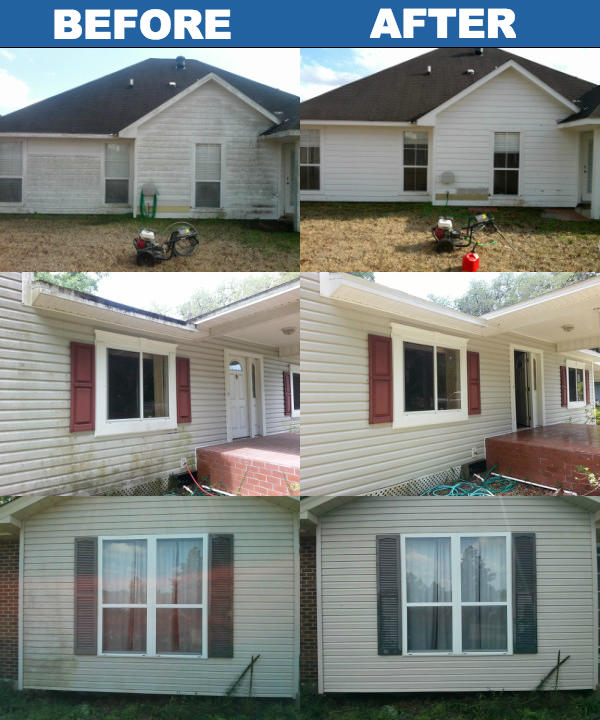
Walking past a car park under construction last week I watched two tradesmen stripping the yellow bay lines with an electric pressure washer. Which raised an obvious question, because that car park has no power.
A few steps back and the answer was sitting in the truck bed: a portable generator, ticking over so quietly I had walked right past it the first time.
That is the part people underestimate. A generator is not only a hurricane purchase. It is what turns a machine that needs a socket into a machine you can take anywhere. So this guide covers the lot: what the numbers on the label actually mean, which style suits which job, how the fuels differ, and which machines are worth buying today.
Jump straight to the picks if you already know what you need.
Quick Look: Best Portable Generators
Six machines that are on sale right now, from a two person camping unit to something that will carry a house:
Honda EU2200i

The one the trades keep buying. Quiet enough to hold a conversation beside, light enough to lift with one hand, and it will still start after a winter in the shed. Rated 4.6 stars.
WEN 56235i
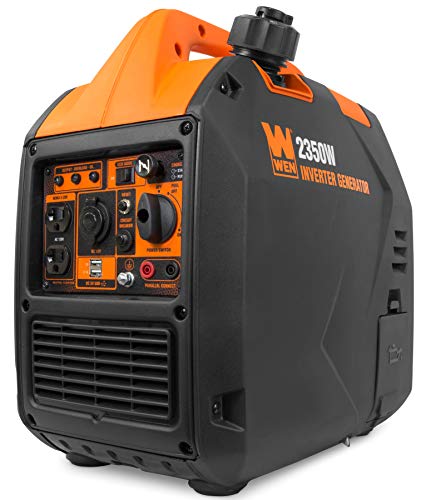
Highest rated here at 4.8 stars. Roughly the same output as the Honda for a fraction of the outlay, with a fuel shut off that keeps the carburettor clean between uses.
Champion 4500W Dual Fuel

A 1,800 PSI electric pressure washer wants around 1,200 running watts but can spike near 3,000 on start up. This one swallows that spike without stalling, and runs on petrol or propane.
Westinghouse 4650W Dual Fuel
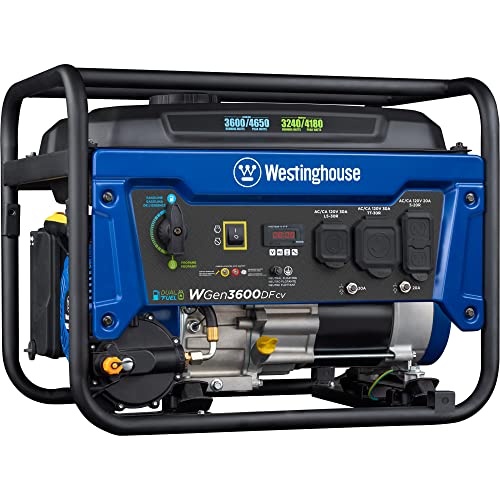
Enough to carry a fridge, a sump pump and the lights through an outage. The RV ready 30A outlet means one cable does most of the work. Rated 4.2 stars.
Champion 9375W Home Backup

The step into whole house territory, where the furnace and the well pump come along too. Wheels and a handle, but it is a two person lift into a truck. Rated 4.5 stars.
Honda EU7000iS

Fuel injection, no choke, and inverter power clean enough for a laptop. Eighteen hours at quarter load. If you buy one generator for the next twenty years, this is it.
Why Buy a Portable Generator?
Because the power always goes out at the worst time. Search traffic for portable generators spikes in the same pattern every few years, and the spikes line up exactly with the big storms. By the time a hurricane has a name, the shelves are already empty. The people who are comfortable during an outage are the ones who bought months earlier, on an ordinary afternoon, for an ordinary amount of money.
To keep the things that cannot wait running. A fridge full of food. A sump pump holding water out of a basement. A heater in January or a fan in August. None of these need the whole house back, they need a few circuits, and that is squarely in portable generator territory.
To have power where there has never been any. Camping, tailgating, hunting, a cabin at the end of a dirt track, a boat ramp. Lights, a fridge, a speaker, a laptop. A quiet inverter unit does all of that without ruining the reason you went.
To keep big batteries alive off grid. A camper battery left alone will flatten itself in days. An hour on a generator puts it back. The same goes for a boat, a trailer or a solar bank in a week of cloud.
And for powering tools that need a socket. Electric pressure washers, saws, compressors, work lights. This is the reason the men in the car park had one, and it is the reason a lot of readers here end up buying one.
6 Considerations When Buying Your Portable Generator
1. Does it have the watts you actually need? Every generator carries two numbers. The big one is surge or starting watts, a brief burst it can hold for a second or two. The smaller one is running watts, usually 70 to 80 percent of the surge figure, and that is what it can hold all day. The gap matters because electric motors draw far more current to get turning than to keep turning. A typical 1,800 PSI electric pressure washer with a 1.5 horsepower motor asks for roughly 1,200 running watts but can spike close to 3,000 on start up. Size for the spike, not the average.
2. How long between refills? Manufacturers quote runtime at half the rated load, so treat the headline figure as a best case. Most portable units go about 8 hours on a tank. The better inverters stretch well past that at light load, which is the difference between sleeping through the night and getting up at 3am to refuel.
3. What are you prepared to spend? A small conventional generator is one of the cheaper tools in a garage. A jobsite machine is a serious purchase. Inverters cost several times more than a conventional unit of the same output, and whether that is worth it depends entirely on the next two questions.
4. Does it need to be quiet? If the answer is yes, buy an inverter. They throttle the engine down when the load is light instead of hammering along at fixed revs, so a good one sits around the volume of a normal conversation. A conventional generator at the same output is a different experience entirely, for you and for your neighbours.
5. How often will you carry it? Inverters are smaller and lighter than conventional units of the same output. Once you get above about 5,000 watts, though, portable starts to mean wheels and a handle rather than a carry grip, whatever the badge says.
6. How many things at once? Count the outlets, not just the watts. A bigger machine gives you more sockets and usually a 30A RV style outlet, which saves running four extension leads out of a window.
How Does a Portable Generator Work?
Strip it back and a generator is a chain of three conversions.
Fuel goes into the engine, where burning it releases chemical energy as heat and pushes the pistons. That is chemical to mechanical. The pistons turn the crankshaft, the crankshaft spins the rotor inside the alternator, and a moving magnetic field drives current through the stator windings. That is mechanical to electrical. The electricity comes out of the sockets.
Chemical to mechanical to electrical, nothing more exotic than that. A hydroelectric dam skips the first step entirely: falling water supplies the mechanical energy, so no fuel is burned at all.
Common Uses of Portable Generators
The list runs long once you start paying attention:
- Topping up a camper or caravan battery on a hunting trip
- Running a portable fridge at a campsite
- Powering speakers, a freezer and lights at a tailgate
- Keeping a sump pump alive through a storm
- Lighting and essentials at a cabin with no mains supply
- Mobile contractors running tools wherever the work is
- Construction sites working before the site is connected to the grid
- Driving an electric pressure washer somewhere with no socket
At the industrial end the word portable stops meaning what you think. On mine sites the diesel units that ran the equipment and the floodlights for night shift needed a forklift to get them off the truck. Same principle, different scale.
Styles of Portable Generator
Three broad families, sorted by what they are built to do.
Recreational
The smallest and the easiest to move. Inverters and compact conventional units live here. If the generator is going to spend its life being lifted in and out of a vehicle, this is the family you want. First time buyers are almost always surprised at how little noise a good inverter makes.
Home and Emergency
Bigger, heavier, and fitted with wheels and a handle so one person can walk it out of the garage. The output is sized for the circuits you care about during an outage rather than for a campsite. This is the family to shop in if backup power is the reason you are buying.
Professional and Jobsite
Built to run all day, every day. The most powerful and the most expensive of the three, with the frames and the duty cycles to match. You will find these on construction sites and anywhere a generator is a working tool rather than an insurance policy.
Inverter vs Conventional Generators
Those three are styles. Cutting across all of them are two types, and the difference is in how the electricity is made.
A conventional generator uses heavy copper windings as the field coil, and the rotor has to spin at a fixed 1,800 or 3,600 rpm to put out the right voltage at the right frequency. Hold those revs or the power is wrong. That is why a conventional unit sounds the same whether it is running a floodlight or nothing at all.
An inverter generator takes the raw alternating current the alternator produces, rectifies it to direct current, then rebuilds it into clean alternating current with microprocessor controlled electronics. The output is stable enough for laptops, phones and anything else with a circuit board in it.
The weight saving comes from the magnets. An inverter uses rare earth permanent magnets on the rotor instead of copper windings, so there is less metal to spin and the magnetic field is at full strength the instant the engine fires. Because the field is constant, the engine no longer has to hold a fixed speed, which is what lets it throttle down to the load and sip fuel.
Shorter version: inverters are lighter, quieter, more efficient and more compact. They also cost considerably more. Honda publish a good technical write up of how they combined the flywheel and alternator to shrink theirs further.
Fuel Types
Gasoline
The default, and the cheapest per kilowatt. The engine works the same way as the one in your car, igniting the fuel with a spark. Petrol is available on every corner, and any small engine mechanic can work on the motor. The catch is storage: it goes stale, so drain or treat the tank if the machine is going to sit, and refresh the fuel each season.
Diesel
More expensive to buy and the standard in heavy industry, because diesels last longer and ask for less attention. There is no spark plug. The piston compresses the intake air until it is hot enough to ignite diesel on contact, then fuel is injected and the charge fires. No ignition electrics means fewer things to go wrong, and the engines are built heavier to handle the harder combustion. In a natural disaster diesel also tends to stay available longer, since so much emergency and military equipment runs on it.
Propane
Burns cleaner and, because it is stored as a gas in a sealed bottle, keeps indefinitely. That alone makes it attractive for a machine that might sit untouched for two years waiting for a storm. If you already carry propane for camping gear it is one less fuel to think about. Plenty of current machines ship as dual fuel and will run on either, which is the easiest way to get the benefit without choosing.
Natural Gas
This used to be the one thing portable generators could not do, and standby units bolted to the side of a house had the category to themselves. That has changed. Tri fuel portable generators now run on petrol, propane or natural gas, and if your home already has a gas line the appeal is obvious: an unlimited fuel supply with nothing to carry and nothing to go stale. A standby generator is still the better answer if you want the whole house to come back automatically, and it is still a far bigger investment.
Solar
Solar generators are not really generators at all. They are a battery, an inverter and a solar panel, with no engine and no combustion. That means silence, no fumes and safe indoor use, at the cost of recharge time and output. The category has moved fast and the better portable power stations will now run a fridge for a working day. For a laptop, phones and lights they are an easier answer than anything with a pull cord.
Brands Worth Knowing
Honda sets the standard at the small end. Quiet, frugal, reliable, and priced accordingly. The company began by supplying piston rings to Toyota, and the money from selling that business funded a motorised bicycle, then an engine of its own, and eventually the engines that power half the equipment in this category.
Generac dominates the standby market and also sells portables and pressure washers. Their residential portables are petrol only, and the reputation is for solid value rather than the last word in refinement.
Champion Power Equipment has built its position on output per dollar. They design their own engines, and much of the range is dual or tri fuel with electric start as standard, which is a lot of feature for the money.
Westinghouse portables are a common sight in home backup, usually dual fuel, usually with a 30A RV outlet, and usually sized around the 4,000 to 9,000 watt band that suits a house.
WEN has been making tools since 1951 and sells gensets across the whole size range. Their small inverters are perennially among the best reviewed budget machines on the market.
Briggs & Stratton is the small engine name on an enormous amount of lawn and garden equipment. The company filed for Chapter 11 in July 2020 and was bought by the private equity firm KPS Capital Partners, with the sale closing that September. The brand and the engines carried on.
DuroMax imports and distributes from California and competes almost entirely on price per kilowatt. No race teams, no advertising budget, cheaper machines.
The Picks, Explained
If money is no object: Honda EU7000iS
Seven thousand surge watts, five and a half thousand running, and the best engineering in the class. What justifies it:
- Runtime. Around eighteen hours at quarter load, six at full rated load.
- Noise. Quiet enough that owners report a neighbour’s machine a hundred feet away being louder than this one standing beside it. It is also a steadier, less ragged sound, which matters more than the decibel figure suggests.
- Fuel injection. No choke to fiddle with, and it starts on the button rather than sending you back to the recoil cord.
- Clean output. Inverter power stable enough that people have measured it as cleaner than their wall socket. Laptops and sensitive gear are not a worry.
- Parallel capable. Pair it with a second Honda when you need more.
Buy this if you want one generator for the next twenty years and never want to think about it again. It still needs its scheduled maintenance, but beyond that it simply works.
See the Honda EU7000iS on Amazon…
Best value: Champion 4500W dual fuel
Four and a half thousand surge watts, electric start, and it runs on petrol or propane. That combination is the sweet spot for most households: enough headroom to start an electric pressure washer or a fridge compressor without stalling, quiet enough to live with, and small enough to move on its own wheels.
Champion design their own engines and build to CARB compliant emissions standards, so the range is legal to sell in all fifty states.
See the Champion 4500W on Amazon…
Best small inverter: Honda EU2200i and the WEN alternative
At the recreational end the Honda EU2200i is the machine everything else is measured against. It is compact, it is frugal, you can talk beside it, and it starts after sitting all winter. The earlier EU2000i that people still ask about was replaced by this one.
The honest counter argument is the WEN. Roughly the same output, a fuel shut off that runs the carburettor dry so it does not gum up between trips, and a rating of 4.8 stars from a very large number of owners, for a fraction of the Honda outlay. If the generator is going to come out six weekends a year, the WEN is the sensible buy. If it is going to earn its living, buy the Honda.
See the Honda EU2200i on Amazon…
Best for home backup: Westinghouse 4650W and Champion 9375W
For backup power the question is simply how much of the house you want back. The Westinghouse at 4,650 peak watts covers the essentials: fridge, sump pump, lights, a few outlets, with a 30A RV outlet so one cable does most of the work. Dual fuel means you can keep propane bottles on hand that will not go stale waiting.
Step up to the Champion at 9,375 peak watts and the furnace, the well pump and the air conditioner come along too. It has wheels and a handle, but be realistic: getting it into a truck is a two person job.